Reader Essay · August 2026 · 8 min read
For 40 Years I Caught Other People's Mistakes in Print. Then I Started Losing My Own Words — Until a Quiet Daily Sound Helped Me Find Them Again.
Words were my whole trade. When they began slipping away mid-sentence, I told myself it was just getting older. My granddaughter — and a stack of research papers — talked me out of that.

For forty years, words were the tools of my trade. I ran the copy desk at a regional daily, and my job was to catch what everyone else missed — the transposed name, the dangling date, the fact that didn't sit right. Reporters used to say I could smell a wrong word from across the newsroom. I never needed notes. The right word was simply there when I reached for it, every time.
So I can tell you the exact evening I got scared. I was at my own retirement dinner, on my feet to give a toast, and I lost the name of a man I'd worked beside for twenty-two years. He was smiling up at me from the second table, and I stood there with my glass raised, reaching for his name the way you reach for a familiar handle in the dark… and closing my hand on nothing.
It wasn't the first slip. There had been small ones for months. Walking into the garage and forgetting what I'd come for. Reading the same lede three times before it registered. Starting a story for Diane and feeling the ending simply evaporate. Each one, alone, was easy to wave off. Everybody does that, people say. And everybody does.
But I had spent four decades noticing the one comma out of place on a page of ten thousand. I knew the difference between a typo and a pattern. And this was beginning to read like a pattern.
The phone call that changed my mind
My granddaughter Nora is finishing a doctorate in a neuroscience lab out on the coast — the family's one real scientist, the one we all corner at the holidays with our aches and worries. One Sunday last fall she called to check in, and I finally said the thing out loud: "Nora, I think my memory is starting to give out on me."
She didn't do what I expected. She didn't rush to reassure me, and she didn't sound alarmed. She got quiet for a second and then asked me the oddest question I'd heard in years:
"Grandpa — do you know that your brain runs on a frequency?"
I laughed. She didn't. She explained that if you wire sensors to a person's scalp, you don't pick up thoughts — you pick up rhythms. Waves. Millions of brain cells firing in time together, like a press run thumping along at a steady speed. Scientists have been recording those rhythms for almost a century, and they have names: fast, tight beta waves when you're rushed and worried. Smoother alpha waves when you're calm. And a slow, deep, rolling rhythm called theta.
"Theta is the one you'd want to know about," she said. "It runs strong in the hippocampus — the part of the brain that files memories. When researchers watch people successfully lock in and call back a memory, theta rhythms are very often right there in the thick of it."2,3
"You spent your whole life getting the timing of a page right," Nora told me. "Your memory has a timing too — and modern life keeps it running at the wrong speed."
Then she said the line that stuck with me for days: we almost never let ourselves drop into those slower rhythms anymore. We wake to alarms, read the news at breakfast, worry through the afternoon, and fall asleep with the set still on. We spend the whole day running the presses at full tilt, she said — and the quiet work of filing and remembering happens best when the machine slows down.
What I found when I did my own homework
I'm no scientist, but I was an editor, which means I don't take a single claim on faith — not even my own granddaughter's. After that call I spent two weeks with my library card and a laptop, reading everything I could find on brain rhythms and memory. A fair amount of it went over my head. But three things kept turning up, in paper after paper:1,2,3
First: the link between theta rhythms and memory isn't fringe science. It has been measured in university laboratories for decades — including work recording directly from the human hippocampus while people memorize and recall.2
Second: these rhythms respond to what we do. Researchers have spent years studying how the brain's timing shifts with rest, with attention — and with sound. There's a whole body of work on structured audio, including "binaural" tones that feed a slightly different frequency to each ear, and its relationship to relaxation, mood, and memory.4
Third: and this is the one that raised the hair on my arms — in 2019, researchers reported in a leading neuroscience journal that when they gently re-synced the brain rhythms of adults in their sixties and seventies, parts of their working memory temporarily performed more like adults decades younger.5 Rhythm wasn't just a byproduct of memory. It looked more like part of the engine.
None of it promised a thing. Careful researchers hedge every sentence, and they're right to. But as an idea it made a kind of sense that nothing else had: maybe my mind didn't need pushing harder. Maybe it needed tuning.
The radio-dial principle
Here's how I finally understood it, in my own language. Anyone my age remembers hunting for a station on an old radio dial. When the signal came in fuzzy, buried in static, you didn't fix it by turning the volume up — that only made the noise louder. You eased the dial, gently, until the needle settled onto the frequency. And suddenly the music was just there, clear, like it had been waiting the whole time.
Nobody forces that to happen. Land on the right frequency and the signal comes through on its own.
When Nora called the next Sunday, I told her about my reading and my radio-dial theory, and I could hear her grinning down the line. That, she said, was the plain-English version of what scientists call entrainment — and it was roughly the thinking behind something she'd been meaning to send me: a listening program a team of audio engineers had built around exactly this body of research. It was called Genius Brain Signal.
"Think of it as tuning the dial for the quiet part of your brain," she said. "Fifteen minutes. Headphones. That's the whole assignment."
What's actually inside the sound
I'll be honest: the name made me wince a little. I've edited enough breathless copy to distrust anything with "genius" stamped on it. But when I looked into how the audio itself was actually put together, it read less like a gimmick and more like a recipe — a handful of deliberate ingredients layered into what simply sounds, to the ear, like deeply calming music:
A theta-range foundation
The slow, deep pulse at the base of every session — tuned to the same unhurried range researchers keep finding alongside memory work in the brain.2,3
A gentle way in
Softer alpha-range tones open each session, easing you out of the day's noise gradually — the way you'd ease the dial toward a station instead of yanking it.
Two ears, two tones
Each ear receives a slightly different frequency — the long-studied binaural technique4 — which is why the program asks for headphones and nothing else.
Music you'd actually choose
The engineering hides inside warm, natural soundscapes. To you it's simply beautiful listening; the structure underneath does the quiet work.
🎧 Everything arrives as digital audio — you stream it or download it, on any phone, tablet or computer, with any ordinary pair of headphones.
My fifteen minutes
I decided to treat it the way I'd treat a new section of the paper: every day, short and honest, no skipping, and no passing judgment on the results for a full month. I picked the fifteen minutes after breakfast, in the chair by the window with my coffee going cold, headphones on, eyes shut. Diane took to calling it my "edition." By the end she wasn't entirely joking.
No fireworks — just the deepest breath I'd let out in months. Whatever else it was, it was the most peaceful quarter-hour of my week, and that alone kept me coming back.
The afternoons shifted first. Less of that four-o'clock fog. I read a whole book of essays cover to cover — the same one I'd been re-reading the first page of since summer.
Small things began landing on time. Errands survived the walk to the garage. And one morning at the diner, a name I hadn't reached for in years was simply there, waiting, before I'd even gone looking.
I still misplace a word now and again — I'm seventy-three, not thirty-three. But the fog doesn't frighten me anymore. My mornings are mine again. So are the names I'd started to lose.
I want to be careful here, because I was an editor and precision is a habit I can't break: I can't promise you my experience. Nobody honestly can — every mind runs its own frequency. What I can tell you is that this was the easiest habit I have ever kept, and the first thing in years that made me feel like I was doing something for my mind instead of just fretting about it.
I'm not the only one
After I mentioned my "edition" in a column for our neighborhood bulletin, I started hearing from other listeners — old colleagues, neighbors, strangers who'd found the program the same way I had. A few of their notes, shared with permission:
"My head at work always felt like a switchboard with every line ringing at once. This is the one thing that quiets it. Fifteen minutes at lunch and the afternoon is actually mine again."
"I bought it for the memory side, but the real surprise was the calm. My wife asked what I kept listening to — now there are two pairs of headphones on the nightstand."
"Career pharmacist, professional skeptic. I gave it thirty days only because the references held up. I'm well past ninety days now, if that tells you anything."
Individual experiences; results vary from person to person.
If you'd like to try what I tried
Nora had to walk me through how these things are sold nowadays — no boxes, no shipping, just instant access on whatever device you already own. The team behind the program currently offers the whole package for less than I used to pay for a decent dinner out, and they give you a full three months to decide whether it's for you. That last part is what finally moved me from reading about it to trying it, so I'm passing all of it along exactly as I found it:
Genius Brain Signal — Full Digital Access
Everything below is included with a single one-time purchase. Nothing ships; everything is available minutes from now.
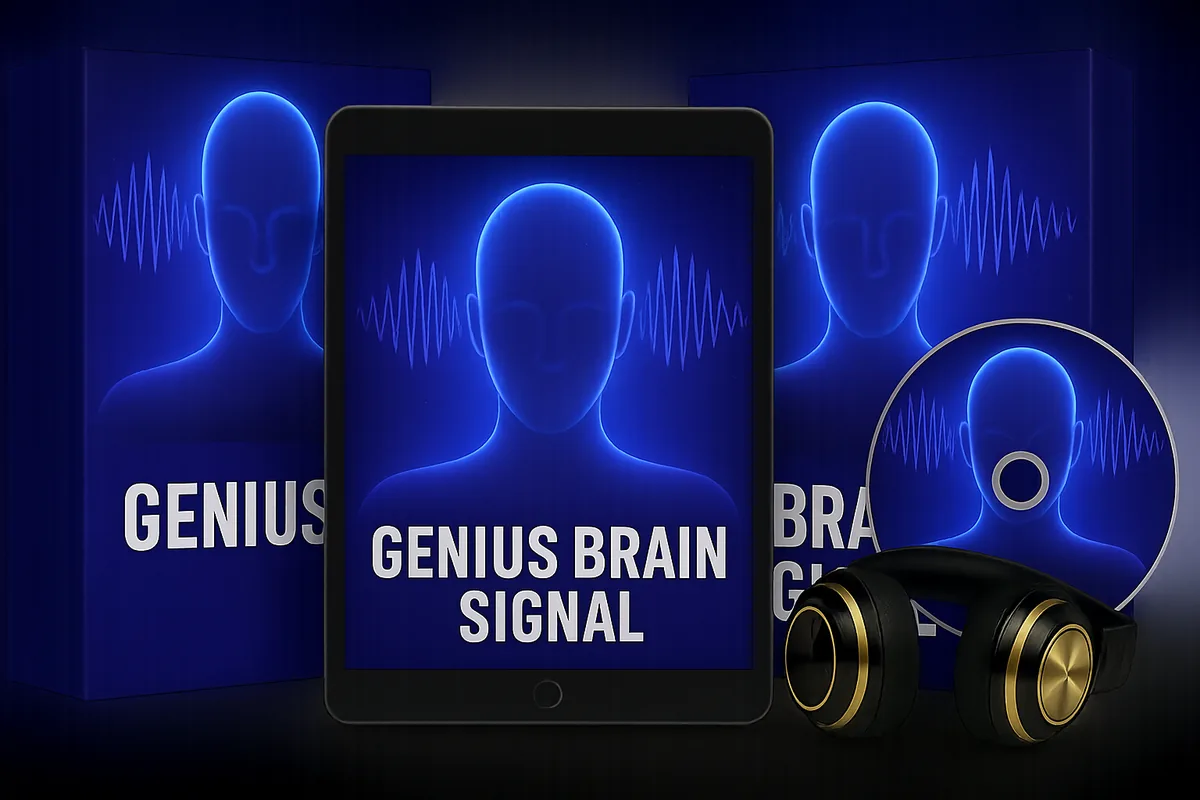
- The Genius Brain Signal Audio ProgramThe complete engineered listening sessions — the daily "edition" itself. $197 value
- Bonus: Quick Start GuideSo your first session is set up right in five minutes. $97 value
- Bonus: Theta Money Magnet AudioA companion session for quiet, abundance-focused visualization. $97 value
- Bonus: The 10X Learning Accelerator GuidePractical techniques for absorbing new material at any age. $97 value
One-time payment · instant access · no subscription, ever
Get Instant Access — $37Listen daily for a full season. If you don't genuinely feel calmer and clearer, one email gets you every penny back — no questions, no forms, no hard feelings.
Questions my friends keep asking me
Is this music? Meditation? What is it exactly?
Do I need special equipment?
How long before I notice anything?
Is it a subscription?
Is this a medical treatment?
P.S. — If you take one thing from an old editor, let it be this: don't wait for a scare to give your mind fifteen quiet minutes a day. Whether it's this program or simply a chair by a window, your memory keeps the timing of your whole life. Mind the timing. — Ray
Background & further reading
The published research that shaped my understanding. These studies examine the underlying science of brain rhythms, sound and memory; they are not studies of this product.
- Klimesch, W. (1999). EEG alpha and theta oscillations reflect cognitive and memory performance: a review and analysis. Brain Research Reviews, 29(2–3), 169–195.
- Lega, B. C., Jacobs, J., & Kahana, M. (2012). Human hippocampal theta oscillations and the formation of episodic memories. Hippocampus, 22(4), 748–761.
- Herweg, N. A., Solomon, E. A., & Kahana, M. J. (2020). Theta oscillations in human memory. Trends in Cognitive Sciences, 24(3), 208–227.
- Garcia-Argibay, M., Santed, M. A., & Reales, J. M. (2019). Efficacy of binaural auditory beats in cognition, anxiety, and pain perception: a meta-analysis. Psychological Research, 83(2), 357–372.
- Reinhart, R. M. G., & Nguyen, J. A. (2019). Working memory revived in older adults by synchronizing rhythmic brain circuits. Nature Neuroscience, 22(5), 820–827.